When treating medical emergencies on the field, the standard procedure for paramedics and first responders is often “load and go.” However, when dealing with Exertional Heat Stroke (EHS), applying standard transport procedures without immediate cooling can prove fatal.
In modern sports medicine, the universally accepted emergency protocol for EHS is straightforward: Cool First, Transport Second.
The Critical Window: 30 Minutes to Core Recovery
Exertional Heat Stroke is defined by a rapid elevation of core body temperature above 104°F (40°C) accompanied by central nervous system (CNS) dysfunction (disorientation, agitation, seizures, or coma). Cell damage, systemic inflammatory response, and organ failure begin when core temperatures remain elevated for extended periods.
Medical literature shows a 100% survival rate when EHS patients are cooled to a safe threshold—below 102°F (38.9°C)—within 30 minutes of collapse. Conversely, delays in cooling lead to severe morbidity, neurological damage, or fatal outcomes.
Why “Transport First” Puts Lives at Risk
Transporting an un-cooled EHS patient in an ambulance poses severe risks:
- Standard ambulances rarely possess cold-water immersion tubs or large supplies of ice water.
- Passive cooling (air conditioning, cold towels, or ice packs on the groin/axilla) provides an inadequate cooling rate ($<0.05^{\circ}\text{C/min}$).
- The time spent loading, transporting, and admitting a patient to an Emergency Department frequently exceeds the 30-minute critical window.
Implementing the Protocol
- Recognize Immediately: If an athlete collapses or displays irrational behavior during high-heat exertion, assume EHS until proven otherwise.
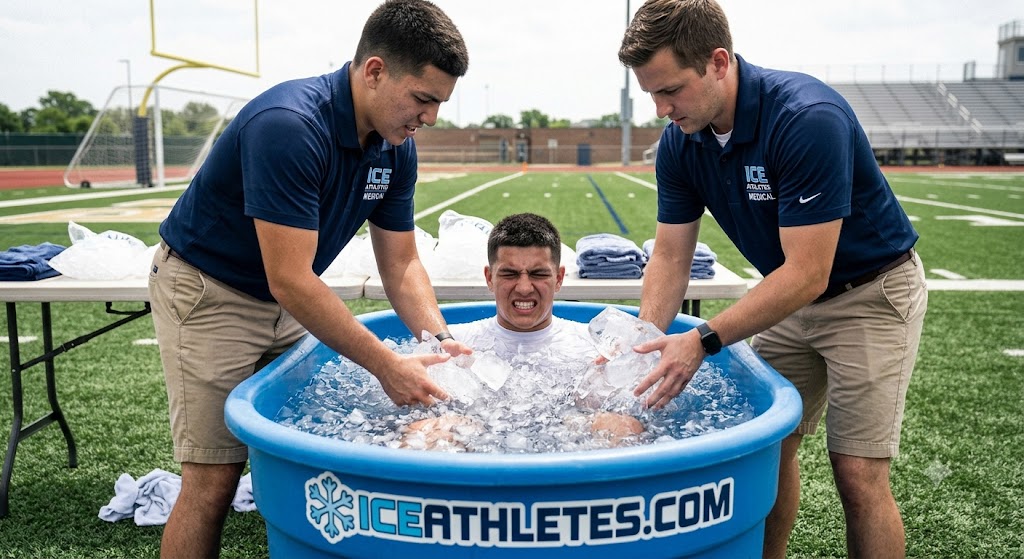
- Initiate Immersion: Immerse the patient immediately in a tub of ice water ($35\text{–}59^{\circ}\text{F}$) or perform the TACO method. Continuously circulate the water over the torso and neck.
- Cool to 102°F: Keep the patient submerged until core temperature drops to $102^{\circ}\text{F}$ (or for roughly 10 to 15 minutes if thermometry is unavailable) before placing them into the ambulance.
By prioritizing rapid, aggressive cooling on-site before transport, coaches, athletic trainers, and emergency personnel ensure that heat stroke remains 100% survivable.
For a visual breakdown of emergency field techniques like tarp-assisted cooling, you can watch this helpful walkthrough on the TACO Method Overview to see how medical personnel structure the protocol on the field.